


Across France and Italy, Road Patrol Alliance 2026 brought European patrol teams together to deliver cross-border roadside assistance throughout the summer. Extending the operation to Italy for the first time gave the campaign a new dimension: a shared model working in two countries, with participating clubs contributing their expertise to assist drivers away from home.
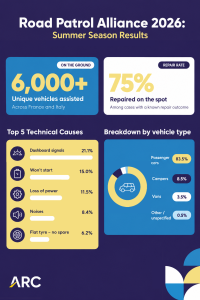
The season has now closed. Current reporting records +6,000 unique vehicles assisted and a 75% repair-on-site rate among cases with a known repair outcome. Behind those figures is a story of coordination, shared expertise and clubs supporting one another’s members. Here is what the available results reveal, and how that experience can inform the next season.
The operation in numbers
In 2025, the operation ran in France with 43 patrol officers and more than 2,500 interventions, according to the campaign’s previous-season reference figures. In 2026, the geographical scope widened. The latest total counts unique vehicles rather than interventions, so it should not be read as a like-for-like growth comparison.
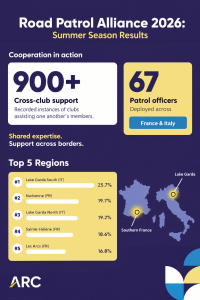
Across the two countries, patrol officers and dispatchers contributed to a coordinated response under the shared ARC Europe framework. Cooperation also translated into recorded assistance between clubs: the requester-provider flows displayed in the operational report add up to 985 vehicle-plate counts. This supports the dashboard’s “900+” figure, although it is not a deduplicated total of vehicles or a complete measure of all cooperation during the season.
What the Italy extension demonstrated
The extension to Italy put a central idea behind the Road Patrol Alliance into practice: organising participating clubs around a shared operation in destinations where summer travel creates demand for cross-border assistance.
For the teams, this meant applying the coordination model in a new territory while maintaining the operation in France. The experience provides a practical basis for reviewing dispatch arrangements, the deployment of roadside expertise and the way participating organisations support one another.
The Italian activity is visible in the operational reporting. Lake Garda South led the individual patrol entries shown, with 200 cases and an average of 4.55 per working day. These are results for one patrol entry, rather than the region as a whole, but they illustrate the operation delivered on Italian roads.
The most technically demanding cases
The available breakdown data provides an initial technical picture of the season. In the dashboard signals represented 21.1% of reported cause counts, followed by vehicles that would not start (11.7%), loss of power (11.5%), noises (8.4%) and flat tyres without a spare (6.2%). These were the most frequently reported categories in the available data. They point to the practical demands faced by patrol teams, while the alliance-wide classification is still being harmonised. The current evidence therefore supports a focus on diagnosis, starting systems, power supply, warning signals and tyre-related assistance. It does not identify a single “most complex” breakdown across the full alliance dataset.
Among cases with a known repair outcome, 75% were recorded as repaired on the spot. Cancellations, refusals, empty rides and undetermined outcomes are excluded from this calculation. The result shows the importance of on-site technical expertise, without assuming that every case required the same level of diagnosis or intervention.
From the field
The operational report gives a clear view of the coordinator’s task even without a personal quotation: assistance had to be organised across participating clubs, patrol locations and two countries, while keeping the service standard consistent. The 985 vehicle-plate counts shown in the requester-provider flows illustrate that coordination in practice, with clubs assisting one another’s members.
The patrol perspective is also visible in the available results. Teams handled a wide range of roadside situations, from dashboard signals and vehicles that would not start to loss of power, noises and flat tyres without a spare. The key figures snapshot records 75% repaired on the spot among cases with a known repaired or not-repaired outcome, showing the practical value of the expertise deployed on the road.
What 2026 proves for 2027
Deployed in France in 2025 and extended to Italy in 2026, the Road Patrol Alliance now has another season of shared operational experience to build on. The next step is to turn that experience into decisions about where teams are needed, how assistance reaches them and how results are measured consistently.
For OEM partners managing assistance programmes across European markets, coordination has a practical purpose: helping organise support for customers who encounter a breakdown abroad. The 2026 campaign offers evidence of participating clubs working together across two countries, while the completed analysis will help identify what to retain and what to improve for 2027.

